


Russia’s aggression against Ukraine has left its footprint on virtually all aspects of Ukrainian life. Aside from the massive death toll and the pain and suffering, it has also brought an unprecedented level of physical destruction. While the material losses are still being tallied, Russia’s invasion keeps taking a toll on invaluable Ukrainian cultural sites.
By Jan Šír.
A church that was converted into a military headquarters. A mass burial site that was desecrated. A theater that was bombed, killing hundreds of civilians, including children, who were seeking shelter there. Art collections that were looted, plundered, or otherwise taken abroad. Libraries that were set on fire. Archival documents that were scattered. Monuments that were dismantled. Archaeological sites that were disturbed. A museum that was flooded as a result of the destruction of a river dam. Historical buildings and entire city quarters that were completely destroyed or razed to the ground during street combat. There are many more.
Against the backdrop of daily battlefield reports and grand geopolitical analyses, the fate of Ukrainian cultural heritage sites that have fallen victim to Russia’s large-scale invasion is somewhat overlooked.
This report features three places that have been damaged as a result of Russia’s military actions during its large-scale invasion of Ukraine. Data for this report were gathered during on-site field trips and visits in Ukraine, conducted in cooperation with the Kharkiv-based NGO Maidan Monitoring Information Center.
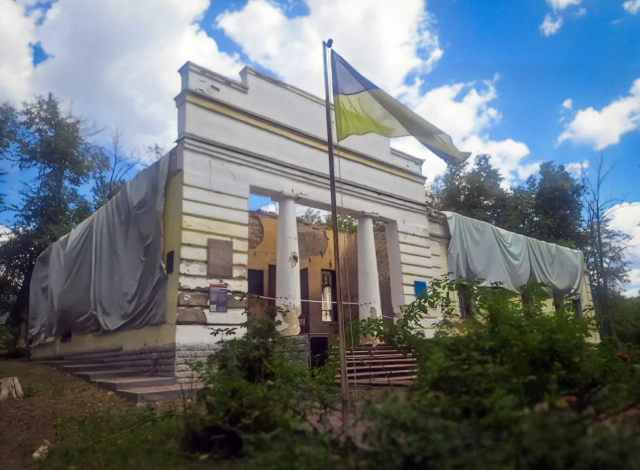
All documented cases cover heritage sites on Ukrainian territory that was under the control of the government of Ukraine at the time of the on-site visit. The ongoing high-intensity conflict and the continued military occupation of parts of Ukraine’s territory make it impossible to visit damaged sites in the zone of active hostilities and in territories under Russian control. Moreover, given the expansion of the zone of conflict and movement of the frontline since the last on-site visit, it is plausible to assume that some of the data presented may no longer mirror the present state of some of the sites.
For obvious reasons, this sample is in no way fully representative. It cannot cover the full range of the damage to Ukrainian cultural sites in all its forms and manifestations. However, it is sufficient to allow for a basic idea of what pressure Ukraine faces in protecting and preserving its cultural heritage, as well as the challenges the Ukrainians are facing as a distinct nation with its own culture in resisting Russia’s aggression.
That said, the sample is no random choice. The selected sites are important lieux de mémoire. They are places that hold special symbolic meaning for the community. They reinforce the common understanding of a shared past and a sense of belonging among community members, as well as the distinct identity of the nation as a whole. Moreover, they all have in common a long history or a connection with a strong personal life story, creating an emotional bond that ties the nation to those sites.
The law of armed conflict prohibits attacks on civilian targets, which by definition include cultural heritage sites. Cultural sites enjoy special protection under international law. As such, the destruction of heritage sites and resulting cultural erasure may be a violation of international humanitarian law and constitute war crimes and crimes against humanity. Also, it may provide supporting evidence of genocidal intent.
As of this writing, the Office of the Prosecutor General of Ukraine has registered over 230,000 war crimes stemming from Russia’s aggression.
The exact number of those crimes that are related to attacks on cultural heritage sites is not available. However, based on the public records of destroyed and damaged property, it is safe to guess that the number will be in the thousands, a toll which is effectively beyond the capacities of any system of justice—national or international—to fully investigate, prosecute and punish.
As of mid-April 2026, the United Nations Educational, Scientific and Cultural Organization (UNESCO) has verified 526 cultural sites in Ukraine as damaged by the ongoing armed conflict.
Russia is a UNESCO member.
Read the full report “Remembrance Under Fire” and see photos and full report in Czech.
Also read MAPPING THE RUSSIAN AGGRESSION AGAINST UKRAINE. Public monitoring report. 2022 – 2024